

String Inverters vs Microinverters: Cost Comparison
When deciding between string inverters and microinverters for your solar system, the choice often comes down to cost and performance. Here’s the key takeaway:
- String inverters are more affordable upfront, ranging from $750 to $1,250 for a 5kW system. Installation is simpler, but they require 1–2 replacements over 25 years due to shorter lifespans (10–15 years).
- Microinverters cost more initially, between $1,500 and $3,000 for the same system size. However, they offer a longer lifespan (20–25 years), require fewer replacements, and perform better in shaded or complex roof layouts, increasing energy output by 5–25%.
Quick Comparison
| Feature | String Inverters | Microinverters |
|---|---|---|
| Upfront Cost (5kW) | $750–$1,250 | $1,500–$3,000 |
| Lifespan | 10–15 years | 20–25 years |
| Replacements (25 yrs) | 1–2 | 0–1 |
| Energy Output | Lower under shade | Higher in shaded areas |
| Warranty | 5–12 years | 25 years |
| Installation | Simpler, ground-level unit | Complex, panel-level units |
For smaller systems (<8kW) on simple, unshaded roofs, string inverters save you money upfront. For larger or shaded systems, microinverters may justify their higher cost with better efficiency and fewer replacements. Balancing your budget with long-term performance is key.
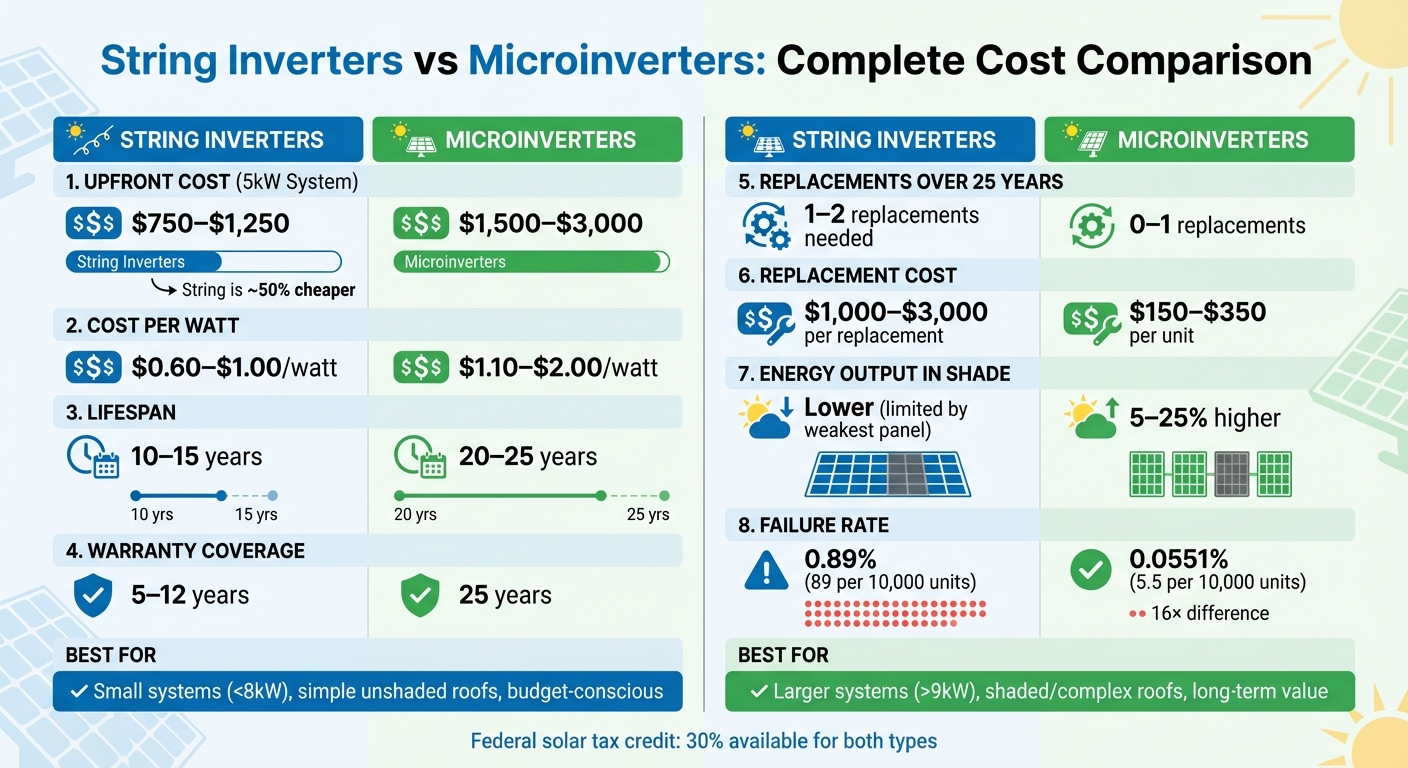
String Inverters vs Microinverters Cost Comparison Chart
Microinverter vs String Inverter: What's The Better Inverter?
sbb-itb-501186b
Upfront Installation Costs
The upfront costs for solar inverter installations vary significantly depending on the type of inverter you choose. String inverters typically cost $0.60–$1.00 per watt, while microinverters range from $1.10–$2.00 per watt. This makes microinverter systems about 15% to 30% more expensive than string inverter setups.
The cost difference comes down to installation complexity. String inverters use a single central unit, usually mounted at ground level or in a garage, which simplifies the installation process. On the other hand, microinverters are installed under each solar panel on the roof. This increases the amount of wiring and labor required, driving up costs. Additionally, compliance with NEC 2023 rapid shutdown requirements adds another layer of expense for string inverters, as they need power optimizers or rapid shutdown devices, which cost $50–$200 per panel.
Cost Per Watt Breakdown
When breaking down the costs, inverter hardware runs between $0.15–$0.24 per watt, with string inverters priced at $800–$2,500 and microinverters costing $150–$350 per panel. Labor adds another $200–$500 to the total.
"String inverter systems run $750-$1,250 for 5kW residential installations, while microinverters cost $1,500-$3,000 for equivalent systems." – EnergyScape Renewables
Inverters generally make up about 6% to 9% of a solar system's total cost. For example, an 8 kW residential system, priced at approximately $3.15 per watt (or $25,200 total), could see savings of $1,000 to $2,500 by opting for a string inverter. These differences become even more apparent with larger systems.
Installation Cost Examples by System Size
To illustrate how system size impacts costs, here’s a comparison of installation costs for string inverters versus microinverters:
| System Size | String Inverter Cost | Microinverter Cost |
|---|---|---|
| 5 kW | $750 – $1,200 | $1,500 – $3,000 |
| 6 kW | $3,600 – $6,000 | $6,600 – $12,000 |
| 10 kW | $6,000 – $10,000 | $11,000 – $20,000 |
| 16 kW | $9,600 – $16,000 | $17,600 – $32,000 |
For a 6 kW system, string inverter installations range from $3,600 to $6,000, while microinverter systems cost between $6,600 and $12,000. Similarly, for a 10 kW system, string inverter setups are estimated at $6,000 to $10,000, compared to $11,000 to $20,000 for microinverters.
The federal solar tax credit can help offset these initial costs by 30%, making the investment more manageable regardless of the inverter type. While upfront costs differ, they pave the way for evaluating long-term expenses and savings.
Long-Term Ownership Costs
Over a 25-year span, string inverters - usually lasting 10–15 years - often require at least one replacement. In contrast, microinverters, which can last 20–25 years, rarely need a full-system replacement.
Replacement and Maintenance Expenses
String inverters typically come with warranties lasting 5–12 years, while microinverters are covered for 25 years. This difference in warranty length means that when a string inverter fails outside its warranty period (a common occurrence), you might face replacement costs ranging from $800 to $2,500 for hardware and an additional $200 to $500 in labor.
"A string inverter is only certified by the manufacturer to last a fifth of the time a microinverter will (5 years vs 25 years). This means you will replace it multiple times before you reach the lifespan of a microinverter." – Jacob Boyd, Solar Industry Expert, PSC Energy
Failure rates further highlight the gap. Microinverters have an extremely low failure rate of 0.0551% (about 5.5 per 10,000 units), compared to string inverters, which fail at a rate of 0.89% (approximately 89 per 10,000 units). That’s a 16× difference. Additionally, when a string inverter fails, the entire system stops producing power until it’s repaired. On the other hand, if a microinverter fails, only the panel it’s connected to is affected, typically reducing the system’s output by just 3–8%.
While string inverters are easier and less expensive to access for repairs, microinverters require roof access for servicing. However, microinverters include free panel-level monitoring, avoiding the need for extra hardware or subscription fees.
Energy Production and Efficiency
Microinverters shine in scenarios involving shaded or complex roof layouts, delivering 5–25% higher energy yields compared to string inverters. Even under optimal, unshaded conditions, string inverters may still produce 4–8% less energy due to factors like uneven panel aging or soiling. Over 25 years, this energy difference can help balance out the higher upfront cost of microinverter systems.
"Microinverters may cost more initially but offer longer warranties, easier upgrades, and up to 25% energy gain in some shaded scenarios, which improves ROI over the lifetime." – VMJ Solar
For homes with roofs that have multiple orientations or partial shading, the increased energy output from microinverters can lead to noticeable savings on electricity bills.
25-Year Total Cost Comparison
The table below compares key cost factors over 25 years for a 6 kW residential system:
| Cost Factor | String Inverters | Microinverters |
|---|---|---|
| Upfront Cost | $3,600 – $6,000 | $6,600 – $12,000 |
| Standard Warranty | 5–12 years | 25 years |
| Expected Replacements | 1–2 times | 0–1 times |
| Replacement Cost | $1,000 – $3,000 per replacement | $150 – $350 per unit (if needed) |
| Monitoring Hardware | $800 + subscription | Included |
| Energy Yield (Shaded) | Lower (limited by weakest panel) | 5–25% higher |
When evaluating the 25-year return on investment, it’s crucial to consider that string inverters will likely require at least one replacement, costing $1,000 to $3,000 in total (including hardware and labor). Microinverter systems, on the other hand, may avoid this cost entirely. If individual microinverter units fail, replacement costs are relatively low - around $150 to $350 per unit.
This analysis offers a more complete picture of the financial impact of each inverter type over time, complementing the upfront cost considerations. Together, these factors help provide a clearer understanding of the long-term value of your investment.
Cost Analysis by System Size
The size of your solar system plays a big role in determining both the upfront and lifetime costs of inverter options. As the size of your solar array increases, the cost difference between string inverters and microinverters changes significantly. Let’s break down how system size impacts the cost dynamics of these two inverter types.
Small Systems Under 8kW
For systems smaller than 8 kW, string inverters are typically the more affordable choice. These inverters are installed at ground level or in a garage and require only one central unit. In contrast, microinverters must be mounted under each individual panel on the roof, which adds complexity and labor costs. For a 5 kW system, hardware costs for string inverters range from $750 to $1,250, while microinverters cost between $1,500 and $3,000.
"Smaller residential systems under 8kW may not justify microinverter premiums unless shading is significant." – EnergyScape Renewables
If your roof is simple, south-facing, and free of shade, the upfront savings of a string inverter are compelling. However, keep in mind that string inverters will likely need to be replaced once during the system’s 25-year lifespan.
Large Systems 9kW and Above
As system size increases, the cost difference between string inverters and microinverters becomes less pronounced. Microinverter costs drop significantly with larger systems, decreasing from $2.00 per watt for a 5 kW system to $1.10 per watt for a 16 kW system. Meanwhile, string inverters maintain a steady cost of about $1.00 per watt, regardless of size.
"Less than 8kW will most likely be cheaper with a string inverter system, but when you go above 8 or 9kW, you get into some intriguing math. The string system will still be cheaper upfront, but by a much narrower margin." – PSC Energy
For a 16 kW system, the upfront cost difference shrinks to $1,600, compared to a $5,000 gap for smaller systems. In larger installations with shading or complex roof designs, the 5–25% energy gain offered by microinverters can make them worth the extra cost. Additionally, new NEC 2023 rapid shutdown requirements require string inverter systems to include power optimizers or other specialized devices, further reducing their traditional cost advantage.
System Size Cost Comparison Table
Here’s a breakdown of per-watt pricing trends, showing how microinverters become more competitive as system size increases:
| System Size | String Inverter Cost | Microinverter Cost | Cost Difference |
|---|---|---|---|
| 5 kW | $5,000 ($1.00/W) | $10,000 ($2.00/W) | +$5,000 |
| 10 kW | $10,000 ($1.00/W) | $13,000 ($1.30/W) | +$3,000 |
| 16 kW | $16,000 ($1.00/W) | $17,600 ($1.10/W) | +$1,600 |
Data sourced from PSC Energy 2025 pricing models
This data highlights that while string inverters are initially more affordable, larger systems with shading or complex layouts may benefit from the energy efficiency and longer warranties of microinverters. For installations over 9 kW, the narrowing price gap makes microinverters a more practical option when you consider their energy yield and durability over time.
Conclusion
When weighing the cost analysis, the balance between upfront expenses and long-term reliability becomes apparent. Choosing the right inverter depends on factors like installation type, system size, and overall budget. For smaller systems under 8 kW on simple, unshaded roofs, string inverters are a more affordable option, costing roughly 30% less upfront. On the other hand, if your roof includes multiple orientations or shading from dormers, trees, or chimneys, microinverters can boost energy production by 5% to 25%.
"For budget-conscious installations on clean, unshaded rooftops, a string inverter is a solid and cost-effective choice." – VMJ Solar
For systems over 9 kW, the difference in upfront costs becomes less pronounced, making microinverters a compelling option. Their 25-year warranty aligns with the lifespan of most solar panels, helping to avoid costly mid-life replacements. This analysis highlights that while string inverters save money upfront for smaller, simpler setups, the added energy efficiency and durability of microinverters can justify their higher initial price in more complex installations.
For those looking to purchase competitively priced new or used inverter equipment, Electrical Trader offers a wide selection. Whether your priority is minimizing initial costs or maximizing long-term performance, the key is to balance your budget with your system's 25-year energy goals.
FAQs
How do I calculate the 25-year payback difference?
To figure out the 25-year payback difference between microinverters and string inverters, you need to weigh their upfront costs against long-term energy savings.
Microinverters generally come with a higher initial price tag - around 20-30% more than string inverters. However, they often shine in energy production, especially in conditions with shading or complex roof layouts, delivering an extra 5-25% energy yield.
To calculate the payback:
- Start with initial costs: Add up the system's upfront expenses, factoring in the higher price of microinverters.
- Estimate energy savings: Consider how much more energy microinverters can generate over 25 years, especially in less-than-ideal conditions.
- Subtract costs from savings: This will give you the net benefit and help you pinpoint how long it takes for the added expense of microinverters to pay off.
This method offers a clear picture of whether the extra investment in microinverters is worth it in the long run.
When does shading make microinverters worth it?
Microinverters are a solid option if your solar panels deal with heavy shading, are installed facing multiple directions, or require detailed, panel-specific monitoring. Unlike string inverters, which connect all panels in a series, microinverters operate independently for each panel. This setup ensures more reliable performance under shaded conditions and provides more accurate energy tracking for each panel.
What do NEC rapid shutdown rules change for cost?
The NEC rapid shutdown rules can add to the overall cost of a solar system due to the need for additional hardware, extra wiring, and increased labor. These measures are designed to bring conductors down to safe voltage levels within 30 seconds, which can lead to higher balance-of-system (BOS) expenses.